

The 12 Pilots of Christmas
Captain Tammie Jo Shults Honored with Texas Aviation Hall of Fame Induction

Captain Tammie Jo Shults, the retired Southwest Airlines pilot who heroically saved 148 lives during a catastrophic mid-flight emergency in 2018, was inducted into the Texas Aviation Hall of Fame on April 11, 2025. The honor recognizes not only her legendary emergency landing but also her pioneering career as one of the first female F/A-18 Hornet pilots in United States Navy history.
"It feels surreal," Shults told MidAmerica Nazarene University, her alma mater, after the induction. "I feel like I don't even qualify to preflight half of those people's planes. I'm humbled." The sentiment reflects the characteristic modesty that has defined her career, even as she joins an elite group of aviation legends in the Texas hall.
Since retiring from commercial aviation in 2020, Shults has dedicated herself to volunteer work and community service in her home state of Texas. She serves as a volunteer pilot for Angel Flight South Central, a nonprofit organization that provides free air transportation for people with serious medical conditions. The former naval aviator and her husband Dean, also a retired Southwest pilot, sit on the organization's board of directors, helping coordinate flights that make critical medical care accessible to families in need.
Every Tuesday, the 63-year-old grandmother volunteers at Oaks Academy, a Texas charter school serving orphans who struggled in foster care, where she teaches Bible stories woven with aviation lessons. She also teaches Sunday school at her church and recently completed writing a Bible study on the book of Esther for her congregation's women's retreat.
Shults' 2025 hall of fame induction adds to an impressive collection of honors, including her 2020 induction into the International Air & Space Hall of Fame and the Wings Club of New York's 2022 Outstanding Aviator Award. Her bestselling memoir "Nerves of Steel" chronicles her journey from a New Mexico ranch girl watching jets overhead to becoming a trailblazing pilot who, when faced with an exploding engine at 32,000 feet, calmly radioed air traffic control and executed a textbook emergency landing in Philadelphia.
Seven years after that fateful flight, Captain Shults continues demonstrating that true heroism extends beyond moments of crisis—it's found in everyday acts of service, mentorship, and giving back to the community that celebrates her extraordinary legacy.
Harrison Ford Receives Conservation Award, Continues Aviation Advocacy Work

Harrison Ford, 83, received the inaugural E.O. Wilson Legacy Award for Transformative Conservation Leadership in 2025 from the E.O. Wilson Biodiversity Foundation, recognizing decades of environmental activism that extends far beyond his legendary Hollywood career. The actor, who serves as inaugural vice chair of Conservation International since 1991, has long used his fame and aviation skills to make tangible differences in conservation and humanitarian efforts.
Ford, who earned his pilot's certificate at age 53 after initially abandoning flight training in the 1960s due to cost, has built an impressive aviation career alongside his acting achievements. Based part-time in Jackson, Wyoming, he volunteers with Teton County Search and Rescue, using his Bell 407 helicopter to assist stranded hikers in the region's challenging mountain terrain. His volunteer rescue work has saved the county significant costs while helping people in genuine emergencies.
Beyond rescue missions, Ford has become a passionate advocate for general aviation and youth aviation education. From 2004 to 2009, he chaired the Experimental Aircraft Association's Young Eagles program, working to inspire the next generation of pilots. He regularly appears at aviation events including EAA AirVenture and serves as an honorary board member of humanitarian aviation organization Wings of Hope.
His unique combination of celebrity status, piloting expertise, and genuine commitment to environmental and humanitarian causes has made him a real-life hero whose impact reaches far beyond the silver screen.
Michael Schneider - Founder of Pilots To The Rescue

Michael Schneider didn't set out to become a hero. The founder and chief pilot of Pilots To The Rescue simply saw a problem and decided to do something about it. In 2015, after learning about abandoned puppies in rural North Carolina scheduled for euthanasia due to lack of shelter space, Michael and fellow pilot Brian Orter flew south for their first rescue mission. That single flight would change everything.
A year later, Michael founded Pilots To The Rescue, a nonprofit organization dedicated to transporting at-risk animals from overcrowded shelters to adoption centers where loving families await. What started as one man's passion has grown into a nationwide movement, with the organization completing 283 missions, flying over 312,000 miles, and saving nearly 5,000 animals by 2025.
In September 2025, Michael was awarded the prestigious Daher Excellence Trophy, presented by the aerospace company behind his rescue plane, the Kodiak 100 nicknamed "Big Paw." The recognition celebrates individuals who exemplify extraordinary commitment and impact in aviation—but for Michael, the real reward comes every time he sees a dog or cat step off his plane and into their new life.
One particularly memorable rescue in September involved a 100-pound dog named Mike (yes, seriously), who was too large to fit in a crate and was scheduled for euthanasia solely because he took up too much space. Michael and volunteer pilot Stephen Nur flew to South Carolina to pick up Mike along with 64 other animals, coordinating a complex mission that required all hands on deck. Today, Mike is safe with a foster family in New Hampshire—alive because someone refused to give up on him.
The organization reached a milestone in 2025: their 5,000th rescue. The honor went to a playful pup named Archer, who caught the eye of volunteer pilot Vikingur—the very first pilot who had stepped forward to volunteer years ago. After flying 50 rescue missions, Vikingur welcomed Archer into his own home, a testament to the ripple effect of compassion that Michael set in motion.
"We're still euthanizing nearly a million cats and dogs in the United States every year," Michael explains from his hangar. "There's no shortage of animals that need to be transported or rescued. In many cases, there are shelters with space—there's just no way to get to them in time. That's where we come in."
Michael's vision extends beyond simply moving animals from point A to point B. He's built a community of volunteer pilots, ground coordinators, and supporters who believe that every life matters. His work proves that aviation can be a force for good, and that one person with a plane and a passion can save thousands of lives.
Jared Isaacman - Billionaire Pilot, Astronaut, and Aviation Pioneer

In March 2025, Jared Isaacman received the prestigious R.A. "Bob" Hoover Trophy from AOPA, joining an elite circle of aviators who inspire a love of flight in others. At 42, the tech billionaire and commercial astronaut has lived several lifetimes worth of aviation achievements—and he's just getting started.
Isaacman's journey began inauspiciously when he dropped out of high school at 16 to found United Bank Card (later Shift4 Payments) from his parents' New Jersey basement with $10,000 from his grandfather. By 2025, Shift4 processes over $260 billion in payments annually, making Isaacman a billionaire with an estimated net worth of $1.4 billion.
But money simply fueled his true passion: flying. Isaacman earned his pilot's license in 2005 at age 22 and rapidly progressed through ratings. In 2009, he set a world speed record circumnavigating the globe in a Cessna Citation CJ2, raising money for Make-A-Wish Foundation. He co-founded the Black Diamond Jet Team, performing at over 100 airshows flying L-39 Albatros fighters in precision formation just 18 inches apart. In 2012, he co-founded Draken International, building the world's largest private air force—over 100 tactical aircraft providing adversary training to U.S. military pilots.
Then came space. In September 2021, Isaacman commanded Inspiration4, the first all-civilian orbital mission, raising $240 million for St. Jude Children's Research Hospital. In September 2024, he led Polaris Dawn, becoming the first private citizen to perform a spacewalk at 460 miles above Earth—higher than any human since Apollo 17 in 1972.
With over 7,000 flight hours and qualifications in numerous military aircraft including his personal MiG-29, Isaacman embodies the pioneering spirit of aviation. His 2023 NBAA Meritorious Service to Aviation Award and 2025 Hoover Trophy cement his legacy as someone pushing humanity's boundaries both in the sky and beyond.
Jere Fountain - The 90-Year-Old Who Never Stopped Flying

At 90 years old, most people would be content to watch planes from the ground. Not Jere Fountain. This North Carolina pilot is still logging over 500 hours annually—and he's using every minute to save lives.
Fountain, a Korean War Army veteran from Richlands, North Carolina, volunteers with Pilots N Paws, a non-profit that transports rescue dogs from overcrowded shelters to their forever homes. While many pilots his age have long since hung up their wings, Fountain qualified to fly corporate jets and shows no signs of slowing down.
"It's a passion, and I always love to fly the little puppy dogs," Fountain says with characteristic understatement.
His aviation journey began in his youth, evolved through military service and model planes in college, and culminated in founding his own aviation company in 1975. After 25 years in the industry, retirement didn't mean grounding himself—it meant finding new purpose in the skies.
Now, Fountain combines his two greatest loves: flying and dogs. When he's not transporting rescue animals across state lines, he flies with his own canine companion, Lizzie, who has become something of a co-pilot herself.
"The little puppies get their forever home," he explains simply, as if there were no higher calling.
At Jacksonville Airport, where Fountain is a fixture, colleague Liz Hurst speaks for everyone who knows him: "There's nobody around here that doesn't know Jere. There's not a story that you wouldn't want to listen to with Jere."
His goal? Keep flying until he's 100.
For the rescue dogs who travel in his plane, that's nine more years of hope taking flight.
Captain Barrington Irving: Record-Breaking Pilot Answers Hurricane Call

When Hurricane Melissa devastated Jamaica in October 2025, Captain Barrington Irving didn't hesitate to answer his homeland's call for help. The Jamaican-born aviator piloted a Boeing 737-800 cargo jet on two relief missions in November, delivering over 100,000 pounds of critical medical supplies to storm-ravaged communities.
"This is my homeland; the soil that I was born on," Irving said. "I wanted to ensure that the people of Jamaica receive the necessary medical supplies that they need to recover."
Irving's humanitarian efforts in 2025 represent the latest chapter in a remarkable aviation career. In 2007, at just 23 years old, he became the youngest person and first Black pilot to fly solo around the world, earning him a place in the Guinness Book of World Records. He completed the 24,600-mile journey in his single-engine aircraft, aptly named "Inspiration."
Born in Kingston, Jamaica, Irving grew up in Miami where he initially dreamed of playing college football. At 15, a chance meeting with airline pilot Captain Gary Robsinson changed his trajectory. That encounter ignited a passion for aviation that would define his life's work.
Beyond humanitarian missions, Irving founded Experience Aviation and The Flying Classroom, nonprofit organizations dedicated to inspiring underrepresented youth to pursue STEM and aviation careers. His work has earned recognition from President Barack Obama, a Congressional Resolution, and NASA's Trailblazer Award.
Irving's Experience Aviation team has previously delivered over half a million pounds of humanitarian aid during crises including Hurricane Dorian in the Bahamas and Hurricane Helene in North Carolina. Through his continued dedication to both aviation and education, Captain Irving embodies the spirit of service that makes heroes.
Lt. Commander Brenda Robinson: Inspiring The Next Generation of Aviators
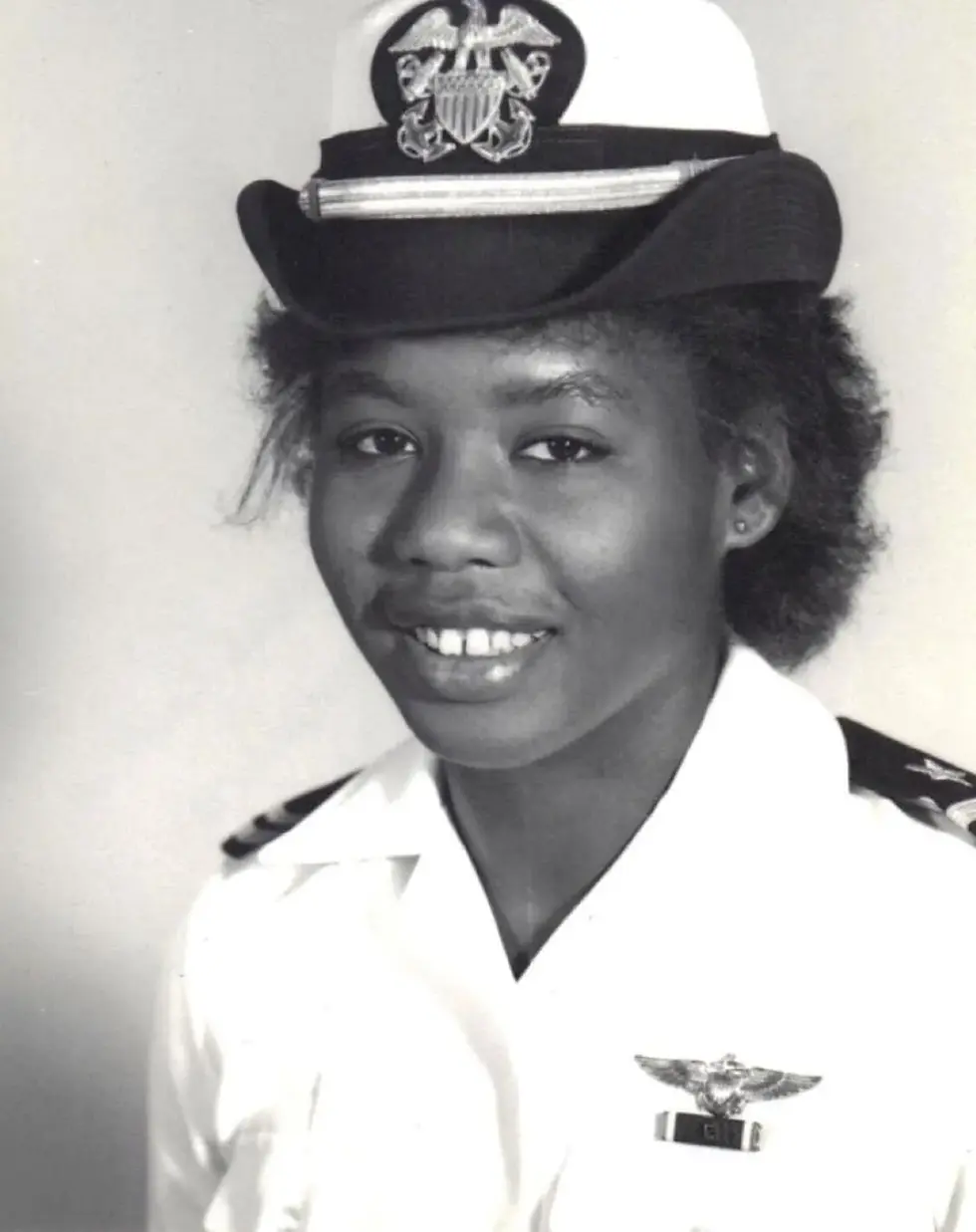
Lieutenant Commander Brenda Robinson never imagined she'd turn left into the cockpit when boarding an aircraft. Growing up in 1960s Pennsylvania, she assumed aviation meant turning right—toward the flight attendant galley. Today, the trailblazing pilot who shattered multiple barriers in naval aviation dedicates her retirement to ensuring young people of all backgrounds know the cockpit is within their reach.
In 2025, Robinson was recognized as a Remarkable Woman finalist for her transformative work with Aviation Camps of the Carolinas, the educational program she founded to expose teenagers to careers beyond traditional expectations. Her action-packed one-day camps at airports across the nation give 9-to-17-year-olds behind-the-scenes access to every facet of aviation—from flight operations to air traffic control to aircraft maintenance.
Robinson's journey to this moment spans 45 years and countless firsts. In 1980, she became the first African American woman to earn her Wings of Gold from the U.S. Navy, selected from just ten women nationwide admitted to Aviation Officer Candidate School. She accumulated 115 carrier landings on aircraft including the USS America, transporting mail, cargo, and passengers in the demanding C-1A carrier onboard delivery role. Her call sign: Raven.
Her naval career included flying admirals, senators, and four-star generals in Washington, D.C., serving as both flight instructor and evaluator, and participating in Gulf War operations. After transitioning to reserves in 1992, Robinson became one of American Airlines' first African American female pilots, flying Boeing 727s, 757s, and 767s for seventeen years.
Now based in Charlotte, North Carolina, Robinson teaches at Fly Right, an FAA-approved flight training center in Concord, where she instructs in simulators and ground school. But her true passion lies in youth mentorship, teaching life lessons wrapped in aviation excitement. "When you can figure out a way to keep a teenager engaged, you have done it—because they're a tough crowd," she says.
Her message to aspiring aviators echoes her own experience: hard work trumps genius, mentorship matters, and doors you didn't know were closed can open wide. Robinson's legacy proves that turning left into the cockpit is possible for anyone willing to chart the course.
Captain Christopher Pennington: The Delta Pilot Who Won Hearts With Ice Cream Promise to Nervous Flyers

Captain Christopher Pennington became an internet sensation in early November when his pre-flight speech aboard Delta Flight 2052 went viral, amassing millions of views across social media platforms.
On November 6, 2025, as passengers boarded the evening flight from Atlanta to Raleigh-Durham, anxiety filled the cabin. The U.S. government shutdown had sparked concerns about air traffic control staffing shortages and flight safety. Sensing the tension, Pennington stepped into the cabin to address his passengers directly.
"I know we probably have quite a few nervous flyers today," he began, acknowledging the understandable worry. He assured passengers that the aircraft wouldn't move unless both he and his co-captain Michael were absolutely certain it was safe to proceed. But it was his next words that truly resonated.
Pennington shared that before leaving for his trip, his young daughter had recently learned the phrase "ice cream" and made him promise to take her for a treat when he returned home. With emotion in his voice, he declared that nothing unsafe would come between him, his little girl, and that ice cream.
The cabin erupted in applause. Passenger Stacey Ray, who filmed the moment, described how the mood shifted from tense to relieved as everyone took a collective breath.
The video garnered nearly two million likes within days, with commenters praising Pennington's professionalism and humanity. One viewer who attended high school with the captain confirmed he had dreamed of being a pilot his entire life. Colleagues revealed that Pennington regularly writes thank-you cards to passengers, exemplifying his dedication to making travelers feel valued and safe.
Lieutenant Ian Hopper: Coast Guard Pilot Who Led Heroic Texas Flood Rescue

When devastating flash floods struck Kerr County, Texas, in the early hours of July 4, 2025, Coast Guard Lieutenant Ian Hopper and his three-person crew embarked on one of the most harrowing rescue missions in recent Coast Guard history. For their extraordinary courage and life-saving efforts, the crew of Rescue 6553 received medals from Secretary Kristi Noem in a ceremony on July 11, 2025.
The mission began when the Guadalupe River rose rapidly, trapping hundreds of campers—including children from Camp Mystic, a Christian summer retreat—in the path of rushing floodwaters. Flying an HC-65E Dolphin helicopter through a dense storm from Air Station Corpus Christi, Hopper and his crew relied solely on instruments to navigate 150 miles through dangerous conditions.
The crew attempted to reach the hardest-hit area three times over nearly seven hours, facing treacherous weather that would have grounded most aircraft. Finally, they "punched through using their weather radar capabilities," opening a critical lifeline for trapped survivors. Working alongside Army helicopters, Hopper's team coordinated the evacuation of 165 people, directly rescuing 18 themselves.
Aviation Survival Technician 3rd Class Scott Ruskan, in his first major Coast Guard operation, stayed on the ground to coordinate rescues, freeing up crucial space in the helicopter. The crew worked tirelessly through extreme conditions, with young girls and counselors among those they saved.
"In the face of devastating floods in Texas, this Coast Guard aircrew's courageous actions saved lives," said Admiral Kevin Lunday, the Coast Guard's acting commandant. The mission exemplified the Coast Guard's motto—Semper Paratus, always ready—and showed that true heroism means flying into danger when others need help most.
Owen Navarro: Flight Instructor's Cool Composure Saves Teen Student in Night Emergency Landing

When the engine on their small aircraft suddenly failed at 6,000 feet on a pitch-black November night over Oklahoma, certified flight instructor Owen Navarro had just seconds to make life-or-death decisions. With his 16-year-old student pilot Landon Atkinson beside him, Navarro demonstrated the kind of calm professionalism that defines true heroes in aviation.
It was Friday, November 18, 2025, and the pair had taken off from Ponca City Airport, heading back to Sundance Airport in Yukon. Then came the terrifying sound Atkinson described as "a solid loud thud." The tachometer—which shows engine RPMs—instantly dropped to zero. The engine was dead.
For 14 harrowing minutes, Navarro glided the powerless aircraft through complete darkness, with only the ambient light from Interstate 35 below to orient them. He attempted to restart the engine—no luck. With power lines, trees, and moving vehicles to avoid, Navarro made the critical decision to land on Highway 77 in Noble County.
"I kind of watch it to see the headlights illuminate down the street, and at that point, I knew that's what we were going to have to do," Navarro recalled. Threading the needle between obstacles in the dark, he brought the plane down safely on the highway near Yearling Road, just north of Perry.
The landing was so smooth that neither the plane nor its occupants were damaged. "When we landed, the first sounds you hear are the coyotes," Atkinson said, describing the eerie howling echoing across the dark Oklahoma landscape.
Throughout the emergency, Navarro praised his young student's composure: "You were a lot calmer and more relaxed than I probably would have been as a 16-year-old student." But it was Navarro's expert training, quick thinking, and steady hands that turned a potentially tragic engine failure into a textbook emergency landing—and brought both pilots home safely to fly another day.
Mark Finkelstein: Cool Head Saves Life in Ocean Emergency Landing

On the evening of August 2, 2025, Mark Finkelstein lifted off from Cape Fear Regional Jetport in Oak Island, North Carolina, in his two-seater Jabiru aircraft—affectionately nicknamed "Air Finky"—for what should have been a routine 20-minute coastal flight.
Thirteen minutes later, everything changed.
"At some point, the engine started to lose power," Finkelstein recalled. "At a certain point, the engine just stopped altogether and the propeller just stopped."
The 17-year veteran pilot faced an impossible choice: attempt to reach the jetport, aim for a crowded beach, or ditch in the ocean. With beachgoers filling the sand below and no power to return to the airport, Finkelstein made the call to land in the water just off Oak Island Pier.
"My entire focus was to stick to my training," he said. "As per training, no time to be afraid."
The impact flipped the aircraft, leaving it mostly submerged and upside down in the Atlantic. Finkelstein found himself trapped underwater, surviving on a small pocket of air in the back of the cabin. In what could have been his final moments, training kicked in—he had opened the door before impact, giving rescuers a way in.
By extraordinary fortune, the Oak Island Beach Safety Unit was already nearby, having just completed another water rescue. Within minutes, they reached the submerged aircraft. Using drone oversight for coordination, rescuers guided Finkelstein feet-first through the windshield and out from under the water.
The extraction took less than 30 seconds.
Finkelstein walked away with only a minor cut on his leg, later writing on Facebook: "My deepest gratitude to all those who participated in rescuing and caring for me after my water landing. You were literally life savers!"
In August, Finkelstein returned to the Southport Fire Department to personally thank his rescuers and present them with an Appreciation Award—a small gesture for those who gave him a second chance at life.
Wings of Solidarity: The Pilots Who Stepped Up During the 2025 Shutdown

When the federal government shutdown disrupted operations in late 2025, America's airline pilots demonstrated that crew resource management extends far beyond the cockpit—stepping up to support air traffic controllers working without paychecks during the holiday season.
At Dallas-Fort Worth, Captain Michael Torres organized a "Controllers' Pantry," coordinating with fellow pilots to stock a break room with groceries and essentials. "These professionals are working twelve-hour shifts keeping us safe while worrying about Christmas presents for their kids," he said. "We had to do something."
In Newark, United pilots established a hardship fund that provided direct financial assistance to controllers facing immediate crises. First Officer Amanda Chen, who helped coordinate the effort, noted the emotional toll: "One controller broke down when we handed him a check. His car payment was due, and he didn't know how he'd get to work."
The solidarity movement spread rapidly through pilot social media networks. At Minneapolis-St. Paul, pilots donated thousands in grocery gift cards. In Seattle, Captain James Robinson's crew organized meal trains, ensuring hot dinners reached the tower each evening shift.
Southwest pilots at Phoenix Sky Harbor took a different approach, partnering with local restaurants to provide catered lunches throughout the shutdown. "Controllers can't leave their posts," explained Captain Lisa Patel. "We brought the food to them."
Even off-duty pilots contributed. At San Francisco International, retired captains volunteered to handle household repairs and car maintenance for controllers unable to afford unexpected expenses.
"Every flight we operate depends on their expertise and professionalism," said Captain David Martinez, an Alaska Airlines veteran. "When the government abandoned them during the holidays, we weren't about to leave our colleagues behind."


Comments