

Airline Finance 101: Where your Airfare Actually Goes
American, Delta and United collectively generated over $170 billion in revenue in 2025. Yet for every dollar that comes in, airlines keep just four cents in profit. Understanding how the other 96 cents gets consumed explains why the airline business remains, as Warren Buffett put it, "the worst sort of business … one that grows rapidly, requires significant capital to engender the growth, and then earns little or no money."
Here is how a single dollar of airline revenue gets divided up and why so little survives the journey to the bottom line.
$0.38 — Labor: The Biggest Slice of Every Dollar
The largest share of every airline dollar goes straight to the airline’s employees. Labor has overtaken fuel as the single biggest expense for US airlines, now consuming roughly 38 cents of every revenue dollar according to the latest Bureau of Transportation Statistics data. This covers pilots, flight attendants, mechanics, ground crews, gate agents, and corporate staff.
Post-pandemic pilot shortages triggered contract renegotiations that reshaped the cost structure. American Airlines pilots won pay rises of up to 46% in 2023, with Delta and United soon matching. Flight attendants have seen similar gains. American's cabin crew locked in a new deal in 2024, while United's is still being negotiated. Delta, whose cabin crew are not unionised, has kept pace with annual raises of its own. These deals last for years, meaning airlines are locked into paying them whether planes are full or half-empty.

$0.22 — Fuel: The Cost Airlines Cannot Control
The next largest draw on every airline dollar is jet fuel, consuming around 22 cents. Unlike labour, fuel prices are dictated by global oil markets and geopolitical events entirely outside airline control. Prices collapsed below $1 per gallon during COVID in 2020, spiked above $4 following Russia's invasion of Ukraine in 2022, and have since stabilised in the $2.50–$2.80 range through 2024–25.
Airlines try to protect themselves by locking in fuel prices in advance, a practice known as hedging, but nothing removes the risk entirely. A sustained $10-per-barrel jump in oil prices can cost an airline hundreds of millions in a single quarter.

$0.11 — Aircraft Ownership: The Price of Staying Competitive
Owning and operating a fleet of modern aircraft is staggeringly expensive. A single new Boeing 737 MAX lists at roughly $120 million; a widebody 787 Dreamliner exceeds $250 million. Lease payments, loan repayments, and the gradual write-down of aircraft value consume around 11 cents of every dollar.
United alone took delivery of 82 new aircraft in 2025, with over 120 planned for 2026. These investments are funded through debt, operating leases, and cash from operations — meaning a substantial share of revenue is committed to fleet renewal before a single passenger boards.
$0.25 — Other Costs: Everything Else It Takes to Fly
The remaining 25 cents of every dollar is absorbed by the operational machinery required to run an airline day to day. This includes several major sub-categories:
Maintenance, repair and overhaul: Keeping aircraft airworthy is non-negotiable and tightly regulated. MRO costs cover everything from routine line checks between flights to heavy structural inspections that ground aircraft for weeks. These costs have risen sharply due to spare parts supply chain constraints, an ageing global engine fleet, and a shortage of qualified mechanics.
Landing fees, airport costs and ground operations: Airlines pay airports for the privilege of landing, parking aircraft, renting terminal gates, and using ground infrastructure. These charges are largely non-negotiable and rising, driven by major airport infrastructure programmes across the US. Ground handling, baggage systems, and passenger processing add further expense that scales with volumes.
Regional operations, technology, marketing, insurance, in-flight catering and other overheads: individually modest, but collectively significant.
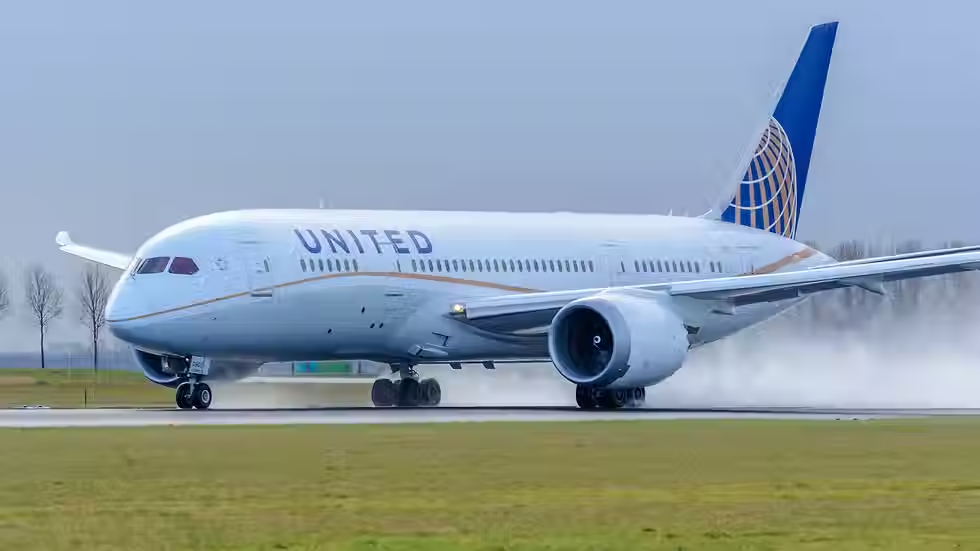
$0.04 — Profit: Crumbs of the Pie
After 96 cents of every dollar has been spoken for, airlines are left fighting over four cents. And even that figure flatters the picture.
The US airline industry averaged a pre-tax profit margin of just 3.6% in the first half of 2025. American Airlines made $111 million in profit on $54.6 billion in revenue for the full year — a margin of just 0.2%. Even Delta, the strongest performer, managed an 8.6% pre-tax margin ($5 billion profit on $58.3 billion in revenue), a figure that would be considered underwhelming in most other industries.
What reaches shareholders is thinner still. American has paid no dividend since February 2020, directing all spare cash towards paying down its $36.5 billion debt. United pays nothing either, ploughing money into new planes instead. Only Delta has restarted dividends, at a modest $0.75 per share a year, roughly a 1% return. Delta also paid out $1.3 billion in profit-sharing to its employees in 2025.
The deeper problem is a structural one. From 1963 to 2023, US airlines rarely earned enough on their investments to cover what that money cost them in the first place, meaning the industry has, over time, destroyed value for shareholders despite decades of rising revenues.
Airlines are trapped in a cycle of pouring billions back into the business just to stay competitive, leaving precious little for anyone else. It is one of the few industries where record revenues and negligible shareholder return go hand in hand.


Comments