

Terms and Conditions Apply: Spirit’s Pilots Didn’t Sign Up to Train Google
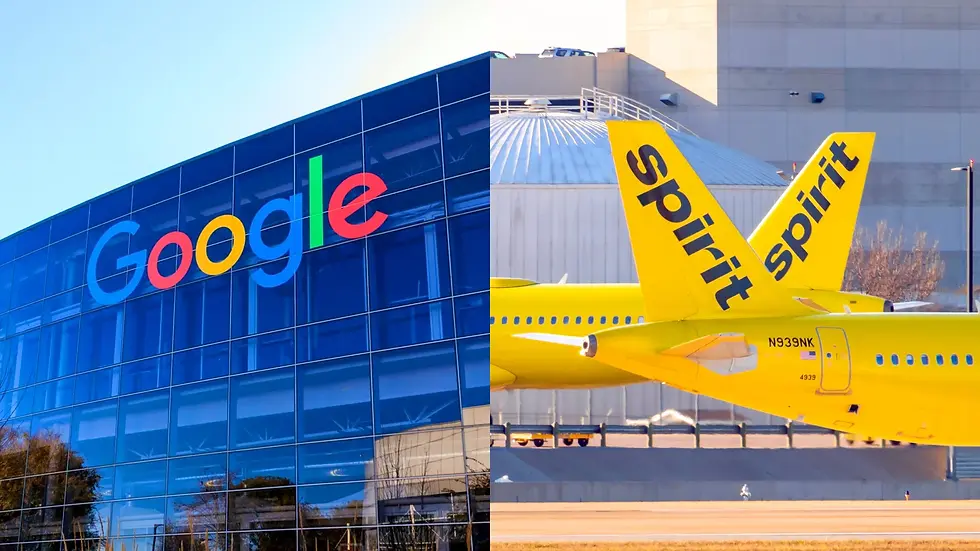
More than 3,000 pilots flew for Spirit Airlines before it stopped operating in May. Many have since found cockpits elsewhere, several hundred of them at American Arilines. What they left behind at Spirit was not just a uniform and a badge but decades of training files, fatigue reports and confidential safety submissions. Those records are now for sale, and the pilots are fighting to keep them out of Google’s hands.
Google’s $10 million bid for the defunct carrier’s internal data was supposed to be a routine line in the liquidation, alongside the aircraft, engines and LaGuardia slots that have already gone. Instead it has become the most contested sale in the entire case, with the approval hearing adjourned repeatedly since August. The next attempt is scheduled for November 6 in the Southern District of New York.
What is actually for sale
The scale explains the interest. The package runs to roughly 100 million emails, 500 million Microsoft Teams messages, calendars, spreadsheets, human resources files, payroll and tax records, timecards, employment contracts and around 30 million lines of software code. Spirit’s pricing models, booking curves, crew schedules, fuel slips and revenue management data are included too. Some of it dates back to 1986.
The auction in August started with a USD 5 million offer from Google. AI data company Mercor pushed the price up before Google closed at USD 10 million, with Mercor left as the backup bidder at USD 7.5 million. Google says the material will help improve its products and AI models and insists it is not buying personal information: anything identifying will be excluded or scrubbed by a third party before it receives a byte.
Spirit has already narrowed the deal. Passenger profiles, the Free Spirit loyalty database, booking and refund records, in-flight purchases and Wi-Fi sales are now out entirely. A vendor, Tonic.ai, has been hired to de-identify what remains. On that basis the court-appointed consumer privacy ombudsman, Lucy Thomson, recommended approval on October 5.
Her report addressed consumers. It said nothing about employees. That is where the fight is.
The pilots’ case
The Air Line Pilots Association (ALPA), which represented Spirit’s flight crews, is not trying to stop the sale. It wants a carve-out. Its filing asks the court to exclude aviation safety data outright, even in de-identified form, naming the Aviation Safety Action Program, Flight Operations Quality Assurance, Line Operations Safety Assessments and fatigue management records.
The reasoning goes beyond privacy. The sale agreement requires the de-identification process to preserve the links between records across the dataset, because those connections are what make it valuable for training AI. The union argues it is therefore almost certain that individual pilots could be identified from the material. Federal law already shields voluntarily submitted safety information from disclosure, and the union says selling it to a company with no interest in aviation safety would chill reporting at every carrier, not just Spirit.
“Our safety system works because pilots and other airline workers trust that when they speak up, it stays confidential,” said ALPA President Jason Ambrosi.
American Airline pilots join the line
On September 29, the Allied Pilots Association (APA), which represents around 16,000 American Airlines pilots, filed its own objection. More than 700 of its members previously flew for Spirit and have training and employment histories buried in the archive. The union told the court the sale threatens to have a damaging effect across all commercial airlines and asked for it to be held until Google can demonstrate verifiable protocols that permanently separate personal identifiers from the commercial data.
The flight attendants got there first. The Association of Flight Attendants-CWA (AFA) argued in August that the de-identification standard was built around consumer privacy and does nothing for confidential employment files, and warned that approving the sale would give every employer an incentive to over-collect staff data in case it ever needs to be monetized in bankruptcy. The machinists’ union and Transport Workers Union (TWU) Local 570 joined that objection. Sara Nelson, the AFA-CWA International President, said the outcome carries implications for workers across the economy.
The Electronic Privacy Information Center filed a brief noting that no employer has ever tried to sell its employees’ data as a bankruptcy asset before. A software vendor, Springshot, wants its own intellectual property carved out. And on October 8 more than 120 members of Congress, led by Senator Elizabeth Warren and Representative Steven Horsford, wrote to the chief executives of both Spirit and Google. Removing names and email addresses does not make a dataset anonymous, the lawmakers argued, and workers have fewer legal protections than consumers even though Spirit collected far more information about them.
Rivals at the door
Google is not the only buyer in the room. AI training startup Micro1 lodged a late USD 12.5 million bid in September, above Google’s offer, and has attached proposed protections for employee data, though it wants to handle the de-identification itself rather than through an independent agent. Mercor remains in reserve, but the ombudsman has flagged a security incident at the company earlier this year that she wants to examine before any switch.
Whatever the judge decides next month will be studied far beyond Fort Lauderdale. It is worth noting what the unions are not asking for. Not one of them is trying to unwind the auction or stop Spirit’s estate from monetizing its records, and most of the pilots whose files are at issue have already moved on to new carriers. What they want is a seat at the table when the terms are set. The question for the court is whether an employee’s claim over the record of their working life extends that far, or whether a payroll file, like a parked aircraft, simply belongs to whoever is left holding the keys.


Comments